
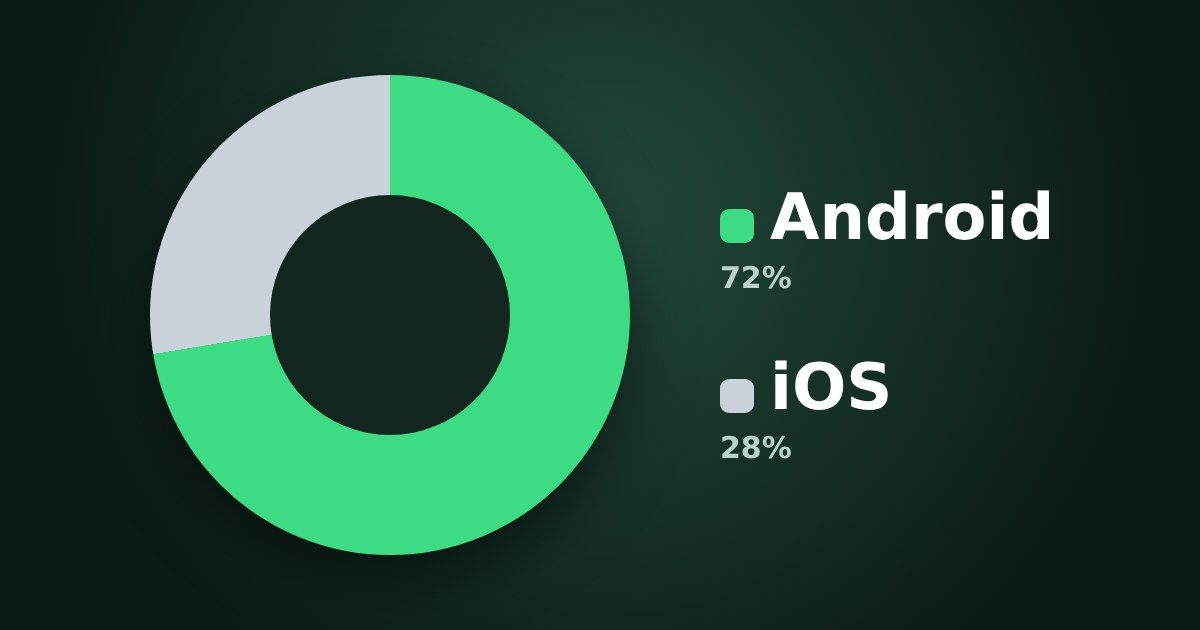
In 2013 I wrote on my old blog about smartphone market shares by operating system (in Dutch). Android already had 81.3% of all smartphones sold, the iPhone 13.4%, followed by Windows Phone (4.1%) and BlackBerry (1%). Those last two no longer exist: Microsoft and BlackBerry both gave up. In 2026 only two players are left: Android and iOS.
1. Worldwide: Android versus iOS
You can measure market share in two ways:
- Sales: the share of newly sold smartphones in a given period. That is what I used in 2013.
- Usage: the share of smartphones actually in use today. StatCounter measures this from visits to more than a million websites.
| Android | iOS (iPhone) | Other | |
|---|---|---|---|
| Sales, Q3 2013 | 81.3% | 13.4% | 5.3% |
| Sales, Q3 2026 | about 77.6% | 22.4% | – |
| Usage, October 2026 | 72.4% | 27.6% | – |
So Android is still the biggest, but the iPhone has gained a lot of ground: from 13% of sales in 2013 to 22% now. Android's share of sales here is an estimate: everything not made by Apple, including Huawei's phones, which run their own operating system (HarmonyOS) in China.
2. By country: almost fifty-fifty in Belgium
The use of Android and iOS differs a lot by country. These are StatCounter's figures for October 2026:
| Country or region | Android | iOS (iPhone) | |
|---|---|---|---|
| Worldwide | 72.4% | 27.6% | |
| Europe | 63.7% | 36.3% | |
| Belgium | 54.6% | 45.4% | |
| Netherlands | 68.4% | 31.6% | |
| Spain | 72.8% | 27.2% | |
| Germany | 72.3% | 27.7% | |
| France | 64.2% | 35.8% | |
| United Kingdom | 49.9% | 50.1% | |
| United States | 48.0% | 52.0% | |
| Japan | 46.2% | 53.8% | |
| China | 69.5% | 30.5% | |
| India | 94.8% | 5.1% |
Bar:AndroidiOS
What stands out:
- In Belgium the iPhone is much more popular than in the Netherlands: 45% versus 32%. Belgium is almost fifty-fifty.
- In the United States, the United Kingdom and Japan the iPhone even has the majority.
- In India almost 95% use Android. Cheap smartphones are especially popular there.
3. By brand: Samsung and Apple on top
Worldwide, Samsung and Apple each sold about the same number of smartphones in the third quarter of 2026. Together they have almost half the market. These are IDC's figures:
| Brand | Shipped | Share | |
|---|---|---|---|
| Samsung | 57.8 mln | 22.6% | |
| Apple | 57.3 mln | 22.4% | |
| Xiaomi | 30.7 mln | 12.0% | |
| OPPO | 25.6 mln | 10.0% | |
| vivo | 19.1 mln | 7.5% | |
| Other brands | 64.8 mln | 25.4% |
Notably, 22% fewer smartphones were sold that quarter than a year earlier, the biggest drop IDC has ever measured. The cause is the memory crisis: because of the huge demand for chips for AI, memory has become much more expensive, and so have smartphones. Many people are therefore keeping their phone longer. Especially the Chinese brands with many cheap models (Xiaomi, OPPO and vivo) are struggling.
4. Which brands do we use in Belgium, the Netherlands and Spain?
The share of brands among smartphones in use, according to StatCounter (October 2026):
Belgium
| Brand | Share | |
|---|---|---|
| Apple | 45.4% | |
| Samsung | 37.6% | |
| Xiaomi | 4.9% | |
| OnePlus | 3.4% | |
| Motorola | 2.0% |
Netherlands
| Brand | Share | |
|---|---|---|
| Samsung | 40.2% | |
| Apple | 31.6% | |
| Xiaomi | 17.7% | |
| Oppo | 1.3% | |
| 1.0% |
Spain
| Brand | Share | |
|---|---|---|
| Apple | 27.2% | |
| Samsung | 27.2% | |
| Xiaomi | 26.4% | |
| Oppo | 6.2% | |
| Motorola | 2.3% |
In Belgium Apple is the most popular brand, in the Netherlands Samsung. In Spain it is a three-way race: Apple, Samsung and Xiaomi each have just over a quarter of the market.
What does this mean for you?
The choice is simpler today than in 2013: it's Android or iPhone. Both are mature, secure and have the same popular apps. Mainly choose what you already know, or what your friends and family use if you want to share photos and messages easily. An iPhone works best with other Apple devices; Android gives you more choice of brands and prices.
Not sure which smartphone to buy? See Which smartphone should you buy? My picks by budget. And the most popular apps are in The most popular apps of 2026 for Android and iPhone.
Questions and comments
Ask a question or leave a comment. It appears only after I have approved it.
No approved comments yet.